
In modern sports nutrition, few dietary supplements have generated as much interest among endurance athletes, bodybuilders, and strength practitioners as L-citrulline. Frequently consumed through natural whole-food sources like watermelon or isolated synthetic powders, citrulline is celebrated for its ability to enhance blood flow and muscular pumps.
However, a recurring discrepancy exists in exercise physiology literature: while natural sources like watermelon juice reliably elevate systemic nitric oxide levels, they often fail to yield significant improvements in high-intensity athletic performance or endurance capacity. Understanding the biochemical divergence between pure L-citrulline and citrulline malate clarifies why this occurs and how athletes can optimize their supplementation strategies.
The Vascular Engine: L-Citrulline and Nitric Oxide Production
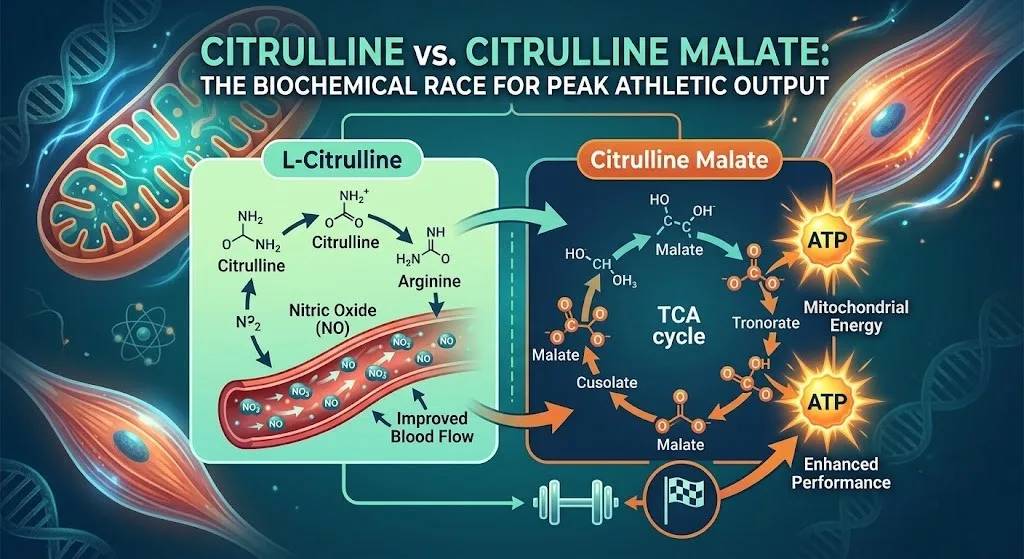
L-citrulline is a non-essential alpha-amino acid that serves as a precursor to L-arginine within the renal system. When ingested, L-citrulline bypasses first-pass hepatic metabolism, leading to a more sustained elevation of systemic L-arginine levels than direct L-arginine supplementation itself.
Mechanistic Role in Performance
-
Endothelial Vasodilation: L-arginine is synthesized into nitric oxide via endothelial nitric oxide synthase (eNOS). Increased nitric oxide expands blood vessels, reducing vascular resistance.
-
Nutrient and Oxygen Delivery: Enhanced arterial diameter facilitates greater localized blood delivery to working skeletal muscle beds, accelerating oxygen supply and metabolic byproduct clearance.
-
Cellular Hydration & Hypertrophy: Increased localized blood flow produces intra-muscular swelling (the "pump"), which acts as a mechanical signal for structural muscle adaptation.
While elevated nitric oxide bioavailability provides metabolic and physiological benefits, vasodilation alone addresses only one side of athletic performance: blood delivery. It does not directly resolve the intracellular energy demands of high-intensity muscular contractions.
The Metabolic Multiplier: Why Malate Matters
Citrulline malate is a compound created by bonding L-citrulline with malic acid (malate), an organic salt intermediate essential to cellular respiration.
The Krebs Cycle Connection
Malate acts as an essential intermediate in the tricarboxylic acid (TCA) cycle, also known as the Krebs cycle. During prolonged or high-intensity exertion, aerobic energy production relies heavily on the steady availability of Krebs cycle intermediates to maintain rate-limiting metabolic steps.
-
ATP Regeneration: By donating malate directly into the mitochondria, citrulline malate accelerates aerobic energy production, increasing rates of adenosine triphosphate (ATP) resynthesis during exercise.
-
Buffering Ammonia and Lactate: Citrulline participates in the urea cycle to clear metabolic ammonia, while malate facilitates the reabsorption of bicarbonate and buffers acidosis during intense anaerobic glycolysis.
-
Delay of Muscular Fatigue: The synergistic effect allows muscle fibers to maintain force production over successive sets or extended endurance trials by reducing systemic fatigue markers.
Whole Foods vs. Engineered Ergogenic Aids
Natural sources such as watermelon juice provide abundant naturally occurring L-citrulline. However, relying strictly on whole-food sources presents distinct physiological limitations for competitive athletes aiming to improve acute athletic metrics:
| Metric / Parameter | Watermelon Juice / Pure L-Citrulline | Citrulline Malate (2:1 Ratio) |
| Primary Mechanism | Vasodilation & Nitric Oxide Synthesis | Vasodilation + Mitochondrial ATP Regeneration |
| Energy Cycle Integration | Minimal direct impact on TCA cycle | High impact via supplemental malate pathway |
| Effective Clinical Dose | Requires ~1.0 to 1.5 liters of juice | 6.0 to 8.0 grams of refined powder |
| Fatigue Resistance | Low to Moderate | High (demonstrated in repeated high-intensity sets) |
| Gastrointestinal Impact | High fluid volume can cause discomfort | Low liquid volume required prior to exertion |
Practical Application and Dosing Strategies for Athletes
To translate these biochemical principles into actionable performance protocols, coaches and athletes should structure supplementation according to training demands.
Dosage and Timing Protocols
-
Optimal Yield: Aim for 6 to 8 grams of Citrulline Malate in a 2:1 ratio (providing approximately 4 to 5.3 g of pure L-citrulline and 2.7 to 2.7 g of malate).
-
Ingestion Window: Consume 45 to 60 minutes prior to training sessions on an empty or light stomach.
-
Consistency: While acute ingestion improves fatigue resistance and work capacity within a single session, chronic daily supplementation over 14 consecutive days optimizes baseline endothelial function and muscle recovery.
Target Sport Demands
-
Powerlifting & Hypertrophy: Citrulline malate increases total rep volume in multi-set resistance exercise and decreases post-exercise delayed onset muscle soreness (DOMS).
-
High-Intensity Interval Training (HIIT) & Combat Sports: The buffering capacity of combined urea clearance and malate energy regeneration helps maintain power output across repeated high-lactate bouts.
-
Endurance Sports: Pure L-citrulline or whole-food sources suffice for baseline cardiovascular health, but citrulline malate is superior when sustained high-power output or sub-maximal surges are required.