In high-performance athletics and bodybuilding, training programs and nutritional regimens are typically designed around a single variable: hormone concentration. Athletes measure serum testosterone, monitor fasting insulin, and schedule nutrient intake to trigger maximal anabolic signaling. However, circulating hormone levels represent only half of the biological equation. Without functional, sensitive cellular receptors, even supra-physiological hormone concentrations fail to elicit optimal biological adaptations.
The limiting factor in athletic performance, muscle hypertrophy, and metabolic recovery often lies at the receptor site. Through structural down-regulation, competitive pathway inhibition, and localized inflammation, target tissues can become resistant to the very chemical messengers driving adaptation. Understanding the physiological mechanisms governing receptor sensitivity—specifically for androgen and insulin signaling—allows athletes and coaches to optimize endocrine responsiveness through strategic dietary and training interventions.
1. The Physiology of Receptor Desensitization
Cellular receptors function as biological transducers, converting extracellular hormonal signals into intracellular cascades. When target cells are subjected to continuous, high-amplitude signaling, they employ homeostatic defense mechanisms to prevent hyper-stimulation.
Down-Regulation and Receptor Turnover
Continuous activation of hormone receptors triggers endocytosis, wherein receptor-ligand complexes are internalized. Once inside the cell, these receptors are either recycled back to the plasma membrane or shuttled to lysosomes for proteolytic degradation. When the rate of degradation exceeds receptor synthesis, total cell-surface receptor density decreases—a phenomenon known as down-regulation.
In addition to physical down-regulation, prolonged pathway activation leads to receptor desensitization via phosphorylation by specific receptor kinases. This decouples the receptor from its downstream signaling proteins, rendering it non-responsive despite remaining on the cell membrane.
Insulin Resistance as a Driver of Endocrine Dysfunction
Chronic elevation of circulating insulin, driven by refined carbohydrate consumption and frequent feeding schedules, induces peripheral insulin resistance. Beyond its well-documented impact on glucose disposal, hyperinsulinemia exerts profound negative effects on the broader endocrine landscape, particularly impacting the androgenic pathway critical for muscular power, recovery, and hypertrophy.
2. Molecular Competition and Crosstalk: Insulin vs. Androgens
At the cellular level, hormone signaling pathways do not operate in isolation; they intersect within shared intracellular networks. The interaction between insulin and androgen signaling within skeletal muscle tissue illustrates how metabolic dysfunction directly impairs anabolic capacity.
Chronic High Sugar / Refined Carbs
              │
              ▼
   Hyperinsulinemia & High ROS
              │
              ├───────────────────────────────┐
              ▼                               ▼
 Over-saturation of PI3K/Akt            IRS-1 Degradation &
       Pathway Traffic                    Inflammation
              │                               │
              ▼                               ▼
 Reduced Androgen Receptor (AR)       Inhibited Signal Transduction
     Signal Transduction                      │
              │                               │
              └───────────────────────┬───────┘
                                      │
                                      ▼
                      Blunted Anabolic Response &
                    Decreased Muscle Protein Synthesis
Pathway Traffic and the PI3K/Akt Bottleneck
Both insulin and androgen signaling utilize the Phosphoinositide 3-kinase (PI3K) and Protein Kinase B (Akt) cascade to mediate cellular growth, survival, and substrate transport. When persistent hyperinsulinemia saturates the PI3K/Akt pathway to drive glucose uptake, intracellular signaling traffic reaches a bottleneck.
Under these conditions, the cell's capacity to transduce signals from the androgen receptor (AR) complex is significantly compromised. Even if free testosterone levels are adequate, the intracellular pathway required to execute gene transcription and stimulate muscle protein synthesis (MPS) remains occupied, effectively blunting the hormone's anabolic potency.
Reactive Oxygen Species (ROS) and IRS-1 Degradation
Excessive carbohydrate loading and continuous high-glycemic flux increase mitochondrial workload, leading to an overproduction of Reactive Oxygen Species (ROS) within muscle tissue. ROS-induced oxidative stress damages key signaling intermediates, most notably Insulin Receptor Substrate-1 (IRS-1).
When IRS-1 undergoes oxidative damage or inhibitory serine phosphorylation, the overall intracellular signaling environment becomes degraded. Because androgen receptors rely on a stable, non-inflamed cellular milieu to assemble co-activator complexes and translocate to the cell nucleus, localized oxidative stress directly impairs androgen responsiveness.
Enzymatic Shifts: The Aromatase Pathway
Hyperinsulinemia combined with increased visceral adiposity promotes the expression of the aromatase enzyme (CYP19A1). Aromatase catalyzes the irreversible conversion of circulating testosterone into estradiol. Elevated systemic estrogen levels exert negative feedback on the hypothalamic-pituitary-gonadal (HPG) axis while simultaneously promoting down-regulation of peripheral androgen receptors, compounding the loss of androgenic sensitivity.
3. Dietary Interventions for Receptor Resensitization
To restore and maintain target tissue sensitivity, athletes must structure their nutritional intake to regulate baseline insulin levels, reduce systemic oxidative stress, and supply essential micronutrients involved in receptor conformation.
       [ Dietary Strategy ]                       [ Physiological Outcome ]

   Targeted Carbohydrate Timing  ─────────►   Low Baseline Insulin & Uncluttered PI3K/Akt
   Intermittent Fasting Window   ─────────►   Autophagic Recycling of Damaged Receptors
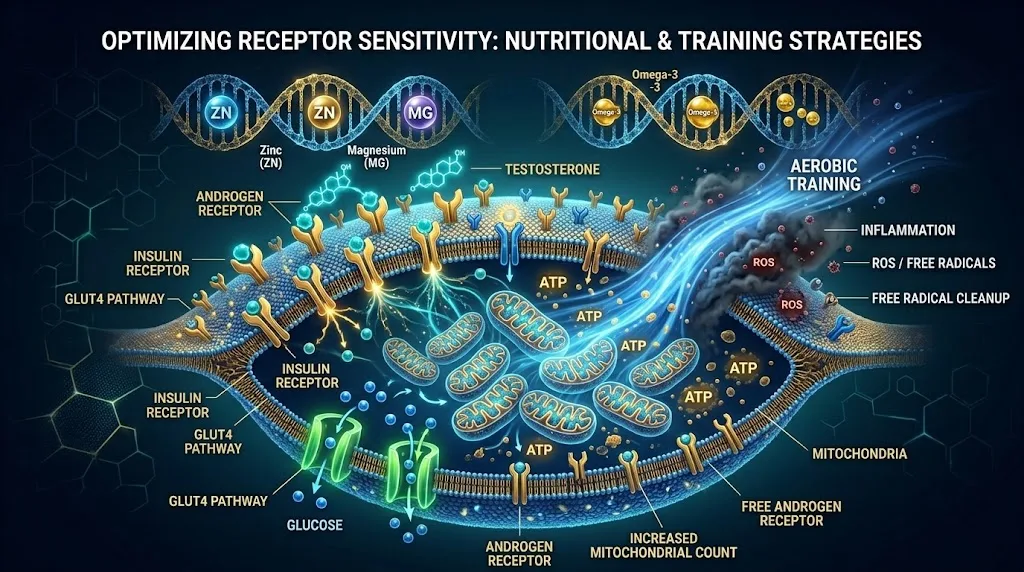
   Zinc & Magnesium Protocols    ─────────►   Preserved AR Binding & Enhanced Free Hormone
   Omega-3 Fatty Acid Intake     ─────────►   Fluid Cell Membranes & Low Systemic Inflammation
Strategic Carbohydrate Periodization
Rather than maintaining constant carbohydrate availability throughout the day, athletes benefit from timing high-glycemic carbohydrate intake strictly around the peri-workout window. Consuming carbohydrates when muscle cells are in a heightened state of contraction-induced insulin sensitivity ensures rapid glycogen resynthesis without requiring prolonged spikes in systemic insulin. During non-training periods, prioritizing lower-glycemic sources, high-quality proteins, and healthy fats keeps baseline insulin low, leaving signaling pathways clear and responsive.
Intermittent Fasting and Receptor Autophagy
Extending the nocturnal fast (16–18 hours) lowers circulating insulin to basal levels, allowing insulin receptors to rest and resensitize. Furthermore, fasting activates cellular autophagy—a lysosomal degradation pathway that clears damaged proteins, mutated signaling molecules, and dysfunctional cell surface receptors. This autophagic turnover facilitates the synthesis and insertion of fresh, fully functional receptors into the cell membrane upon re-feeding.
Micronutrient Optimization for Androgen Function
-
Zinc: Serves as a vital structural component of "zinc finger" domains within the androgen receptor structure. These zinc finger motifs are essential for the AR complex to bind to specific DNA sequences (Androgen Response Elements) and initiate gene expression. A deficiency in zinc directly compromises the DNA-binding capacity of activated androgen receptors.
-
Magnesium: Modulates total bioavailable testosterone by decreasing its binding affinity to Sex Hormone-Binding Globulin (SHBG). By increasing the un-bound, free fraction of circulating testosterones, magnesium ensures adequate ligand availability for sensitive tissue receptors.
-
Omega-3 Fatty Acids: Eicosapentaenoic acid (EPA) and docosahexaenoic acid (DHA) integrate into the phospholipid bilayer of cell membranes. Enhancing membrane fluidity optimizes the mobility and structural stability of embedded receptor proteins while down-regulating pro-inflammatory cytokine cascades.
4. Aerobic Exercise as an Endocrine Reset Mechanism
While high-intensity resistance training creates the mechanical tension necessary to stimulate structural muscle growth, moderate-intensity aerobic exercise acts as a powerful systemic restorer of receptor sensitivity and metabolic flexibility.
Mitochondrial Biogenesis
Cardiovascular training upregulates Peroxisome proliferator-activated receptor gamma coactivator 1-alpha (PGC-1α), the master regulator of mitochondrial biogenesis. Increasing mitochondrial density expands the cell's capacity for glucose oxidation and lipid beta-oxidation. With a larger mitochondrial network handling energy substrates, muscle cells require less insulin stimulation to clear nutrients from the bloodstream, effectively lowering overall insulin requirements.
Non-Insulin Dependent Glucose Disposal (GLUT4 Translocation)
Skeletal muscle contraction during aerobic activity stimulates AMP-activated protein kinase (AMPK). AMPK activation triggers the translocation of Glucose Transporter Type 4 (GLUT4) storage vesicles directly to the cell membrane, completely independent of insulin receptor binding.
This non-insulin-dependent pathway provides two primary benefits:
-
It allows rapid glycogen replenishment and glucose clearance without elevating circulating insulin.
-
It reduces operational demand on the primary insulin receptor network, allowing those receptors to rest and regain baseline sensitivity.
Physical Contraction / Aerobic Exercise
                  │
                  ▼
            AMPK Activation
                  │
                  ▼
   GLUT4 Translocation to Membrane
                  │
                  ▼
Insulin-Independent Glucose Clearance ──► Reduced Load on Primary Insulin Receptors
Capillarization and Systemic Anti-Inflammatory Effects
Low-to-moderate intensity aerobic training (Zone 2 cardio) enhances capillary density within skeletal muscle (capillarization). Improved microcirculation increases the delivery rate of endogenous hormones to target tissues, ensuring uniform tissue perfusion without requiring high circulating hormone concentrations.
Additionally, regular aerobic exercise promotes the release of anti-inflammatory myokines (such as IL-6 released in an exercise-induced, non-inflammatory context), suppressing chronic low-grade systemic inflammation and preserving the integrity of downstream hormonal signaling cascades.
5. Practical Application Protocols for Athletes
To systematically maintain receptor sensitivity for long-term athletic development, the following framework can be integrated into regular periodization:
| Intervention Domain | Recommended Protocol | Primary Physiological Mechanism |
| Nutritional Timing | Confine simple carbohydrates to a 2-hour pre-/post-workout window. | Minimizes daytime insulin exposure; prevents PI3K/Akt signaling overload. |
| Fasting Windows | Implement a 14–16 hour daily fast or a weekly 24-hour fast. | Stimulates cellular autophagy and receptor turnover. |
| Cardiovascular Training | Perform 20–40 minutes of Zone 2 aerobic exercise 2–4 times per week. | Promotes AMPK-mediated GLUT4 translocation and mitochondrial biogenesis. |
| Micronutrient Support | Daily supplementation of Zinc (15–30 mg), Magnesium (300–400 mg), and Omega-3s (2–3 g EPA/DHA). | Supports AR zinc-finger domain structure, membrane fluidity, and SHBG modulation. |
| Recovery Management | Periodize high-volume training blocks with deload weeks. | Suppresses systemic ROS and pro-inflammatory cytokines that disrupt IRS-1. |
Conclusion
Hormonal concentration is only one element of biological adaptation. By managing nutrient timing, reducing systemic inflammation, leveraging aerobic conditioning, and maintaining optimal membrane dynamics, athletes can maximize cellular receptor sensitivity. Ultimately, optimizing receptor efficiency creates an internal environment where endogenous hormones can exert their full anabolic and metabolic potential, yielding superior athletic performance, recovery, and tissue adaptation.