The Hidden Danger of the ECA Stack in Enhanced Athletics: Cardiovascular Strain and Platelet Dysfunction - Featured image for article about steroid education
June 19, 20265 min

The Hidden Danger of the ECA Stack in Enhanced Athletics: Cardiovascular Strain and Platelet Dysfunction

FitKolik

FitKolik

Published on June 19, 2026

The ECA stack plus steroids creates a lethal mix: extreme blood pressure paired with aspirin's crippled blood clotting risks fatal internal bleeding.

In the pursuit of peak conditioning, competitive athletes—particularly bodybuilders during "cutting" phases—frequently turn to thermogenic agents to accelerate fat loss while preserving lean muscle mass. Among the most enduring protocols is the ECA stack, a combination of ephedrine, caffeine, and aspirin.

While the synergistic metabolic effects of ephedrine and caffeine are well-documented, the inclusion of aspirin is often misunderstood. More importantly, when the ECA stack is deployed alongside anabolic-androgenic steroids (AAS), it creates a volatile physiological environment that exponentially increases the risk of catastrophic cardiovascular and hemorrhagic events.

The Pharmacological Synergy of the ECA Stack

The primary fat-burning mechanism of the ECA stack relies on the interaction between ephedrine and caffeine.

  • Ephedrine acts as a sympathomimetic agent, stimulating the release of norepinephrine and directly binding to beta-adrenergic receptors. This increases thermogenesis, metabolic rate, and lipolysis.

  • Caffeine prolongs this effect by inhibiting phosphodiesterase (PDE) enzymes, preventing the breakdown of cyclic adenosine monophosphate (cAMP), a crucial secondary messenger in the lipolytic pathway.

However, the body naturally employs a negative feedback loop to curb this overstimulation, releasing prostaglandins (specifically PGE_1) and adenosine to inhibit further norepinephrine release. This is where aspirin enters the protocol. As a non-steroidal anti-inflammatory drug (NSAID), aspirin inhibits the cyclooxygenase (COX) enzymes, thereby blocking prostaglandin synthesis. By removing this biological brake, aspirin theoretically prolongs the thermogenic and lipolytic stimulus of ephedrine and caffeine.

The Platelet Problem: Irreversible Inhibition

While aspirin serves a specific biochemical purpose in the stack, its systemic side effects pose a severe threat to athletic health.

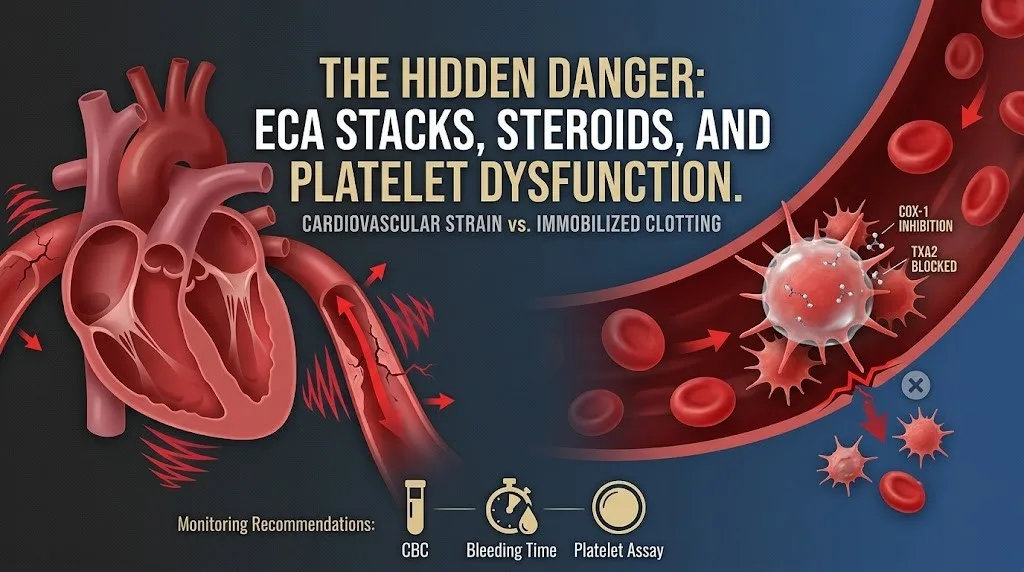
Aspirin acetylates the COX-1 enzyme within blood platelets, completely blocking the production of thromboxane A_2(TXA_2), a potent promoter of platelet aggregation. Because platelets are anuclear fragments, they lack the cellular machinery to synthesize new proteins. Consequently, this enzymatic inhibition is irreversible and persists for the entire lifespan of the platelet, which is typically 7 to 10 days.

During this window, the body’s primary mechanism for initiating blood clotting is severely compromised. For a typical individual, low-dose aspirin therapy carries a manageable risk profile. For an athlete undergoing rigorous training or utilizing other performance-enhancing drugs (PEDs), it can be dangerous.

The Compounding Danger of Anabolic Steroids

The physiological risk escalates dramatically when an athlete combines the ECA stack with anabolic-androgenic steroids. AAS use inherently alters the cardiovascular and hematological profile of the user through several mechanisms:

  • Hypertension: Many anabolic steroids cause significant fluid retention and increase peripheral vascular resistance, leading to chronic elevations in blood pressure.

  • Erythrocytosis: AAS stimulate the kidneys to produce erythropoietin (EPO), resulting in an overproduction of red blood cells. This drastically increases blood viscosity (hematocrit), forcing the heart to pump thicker blood through the vascular system.

  • Vascular Fragility: Chronic structural alterations in blood vessels due to intense resistance training and PED use can weaken arterial walls over time.

When an athlete introduces ephedrine and caffeine into this environment, blood pressure spikes even further due to acute vasoconstriction and increased heart rate. If a micro-tear or structural failure occurs in a blood vessel under this extreme hydrostatic pressure, the body relies on platelets to plug the leak immediately. However, if the athlete is concurrently using aspirin, their platelet function is crippled.

The Pathological Consequence: The combination of extreme vascular pressure (driven by AAS, ephedrine, and caffeine) and a failed clotting mechanism (driven by aspirin) creates a perfect storm for internal hemorrhaging. This significantly elevates the risk of hemorrhagic strokes, gastrointestinal bleeding, and internal organ damage, any of which can be fatal.

Harm Reduction and Clinical Monitoring for Athletes

For athletes choosing to utilize these compounds, prioritizing harm reduction is critical to mitigating severe long-term pathology.

1. Avoid Compound Stacking

The ECA stack should never be used concurrently with anabolic steroids or other compounds known to elevate blood pressure and blood viscosity. The overlap of mechanisms drastically narrows the margin of safety.

2. Limit Aspirin Dosages

If aspirin is utilized within a thermogenic protocol, dosages should be strictly restricted to low-dose or "baby" aspirin levels (typically 75 mg to 100 mg per day). Exceeding these dosages does not linearly increase thermogenesis but does aggressively increase gastrointestinal and systemic bleeding risks.

3. Comprehensive Hematological Screening

Athletes leveraging these protocols must undergo regular clinical assessments to monitor their coagulation profiles and cardiovascular health. Key diagnostic markers include:

Test Purpose
Complete Blood Count (CBC) To monitor platelet count and ensure hematocrit levels have not exceeded safe thresholds (typically keeping hematocrit below 50%).
Bleeding Time (BT) An in vivo assessment of how quickly platelets interact with the vessel wall to form a clot.
Platelet Function Assay (PFA) An in vitro screening tool that provides a highly sensitive measurement of aspirin-induced platelet dysfunction.

Ultimately, the marginal thermodynamic advantage gained by adding aspirin to a fat-burning regimen rarely justifies the profound cardiovascular and hemorrhagic risks, particularly when superimposed on an enhanced athletic framework. True optimization requires balancing performance goals with rigorous physiological preservation.

Share this article