
For decades, athletes and coaches viewed lactate—often mistakenly referred to as lactic acid—as the primary antagonist of performance. It was seen merely as a metabolic waste product, the culprit behind the burning sensation in muscles during intense effort and a herald of fatigue. However, sports science has undergone a significant paradigm shift regarding this molecule.
Modern research now understands lactate as a crucial fuel source for the heart, brain, and muscles during exercise. Even more recently, a groundbreaking role for lactate has emerged: it functions as a potent signaling molecule that communicates deeply within cellular structures to regulate metabolism.
A critical discovery in this area reveals how high-intensity exercise specifically utilizes lactate to signal the body to cease the production of new fat. This mechanism provides a molecular explanation for why High-Intensity Interval Training (HIIT) and similar anaerobic threshold protocols are uniquely effective for managing body composition in athletes.
The Metabolic Players: FASN and De Novo Lipogenesis
To understand the impact of intense exercise on fat storage, we must first understand how the body creates fat. The process of converting non-fat energy sources, primarily excess carbohydrates, into fatty acids to be stored as adipose tissue is known as de novo lipogenesis (DNL).
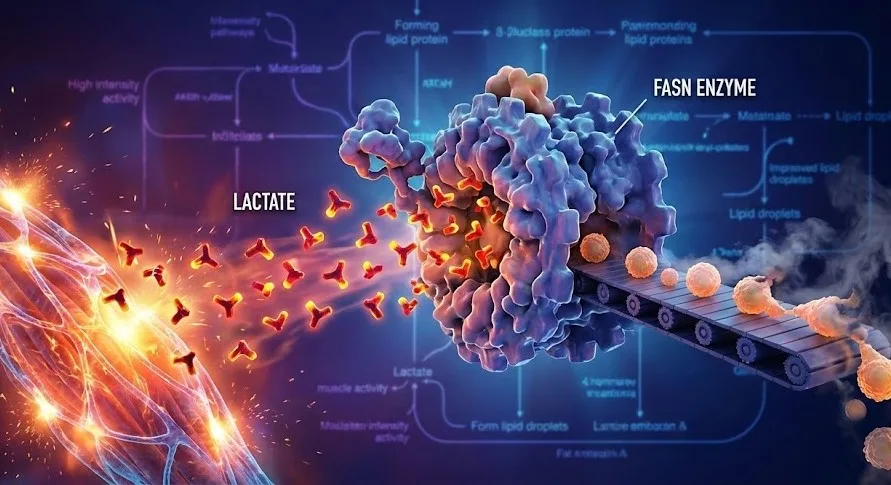
The central engine of this process is an enzyme called Fatty Acid Synthase, or FASN. FASN acts as the molecular assembly line that constructs long-chain fatty acids, which are subsequently stored as body fat. In a state of caloric surplus and low physical activity, FASN is highly active. For athletes striving for optimal power-to-weight ratios or lean body mass, overactive DNL is counterproductive.
The Lactate Switch: The Mechanism of Lactylation
The connection between intense exercise and fat inhibition lies in a newly discovered chemical process called "lactylation."
When an athlete engages in high-intensity training—such as sprinting, heavy Olympic lifting complexes, or intense interval sessions—the demand for energy outpaces the muscles' ability to utilize oxygen. The body shifts to anaerobic metabolism, producing significant amounts of lactate.
This surge in circulating lactate does not merely eventually flush out of the system. Instead, lactate molecules enter cells and physically attach themselves to various proteins, altering their function. This attachment process is lactylation.
Crucially, researchers have found that lactate directly lactylates the FASN enzyme. When lactate attaches to FASN, it changes the enzyme's shape and structure. This modification effectively acts as a molecular brake, inhibiting FASN's enzymatic activity. By suppressing FASN, the high levels of lactate generated during intense exercise directly downregulate de novo lipogenesis.
In simpler terms, the chemical byproduct of hard work tells the body's fat-producing machinery to shut down.
Implications for Athletes and Performance
This biological pathway has profound implications for sports performance and training methodology, moving beyond simple "calories in versus calories out" models.
1. Strategic Body Composition Management For weight-class athletes (combat sports, weightlifting) or those where leanness correlates with performance (endurance running, gymnastics), this mechanism highlights the importance of intensity. While low-intensity, steady-state cardio utilizes existing fat for fuel, high-intensity work actively prevents the creation of new fat at a cellular level. This suggests that incorporating HIIT allows athletes to maintain leaner physiques even during phases of higher carbohydrate intake necessary for fueling performance.
2. Metabolic Flexibility and Efficiency The inhibition of DNL directs metabolic traffic. By shutting down the pathway that turns carbohydrates into fat, the body is encouraged to utilize those carbohydrates for immediate glycolytic energy needs or glycogen replenishment. This enhances metabolic flexibility—the body's ability to efficiently switch between fuel sources based on demand.
3. Validating Anaerobic Training across Disciplines This research provides strong biological validation for the inclusion of high-intensity anaerobic work even in predominantly aerobic sports. A marathon runner, for instance, benefits from tempo runs or interval sessions that spike lactate, not just for cardiovascular speed improvements, but for the metabolic signaling that optimizes long-term body composition.
Conclusion
The old adage "feel the burn" has taken on a new, scientifically validated meaning. The burning sensation associated with high lactate accumulation is not just a sign of effort; it is the feeling of a powerful metabolic signal being sent throughout the body. By engaging in training intense enough to generate significant lactate, athletes are harnessing a sophisticated physiological switch that actively suppresses the synthesis of new fat, optimizing their physiology for peak performance.