
In the pursuit of peak physical performance and aesthetic refinement, athletes often scrutinize every metabolic lever available. Recently, discussions within the sports science community have circled around the impact of Combined Oral Contraceptives (COCs) on female hypertrophy. While some surface-level data suggests a correlation between COC use and increased lean mass, a deeper physiological dive reveals that these "gains" may be more fluid than fiber.
The Mechanism: Ethinyl Estradiol and Fluid Dynamics
Most modern birth control pills utilize ethinyl estradiol, a potent synthetic form of estrogen. Unlike endogenous estrogen produced by the body, synthetic variants can significantly alter the osmotic pressure within muscle cells.
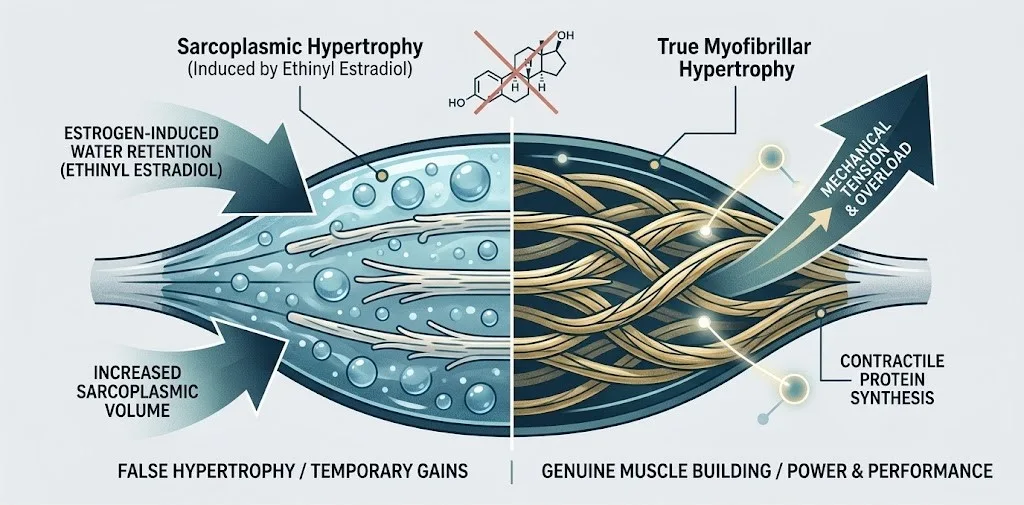
Estrogen has a well-documented relationship with sodium and water retention. When athletes consume COCs, the synthetic hormone levels can lead to an increase in sarcoplasmic volume. The sarcoplasm is the fluid and energy-storing portion of the muscle cell, surrounding the myofibrils (the actual contractile proteins).
Myofibrillar vs. Sarcoplasmic Hypertrophy
To understand why this matters for an athlete, one must distinguish between the two types of muscle growth:
-
Myofibrillar Hypertrophy: An increase in the size and number of contractile proteins (actin and myosin). This results in genuine increases in force production and strength.
-
Sarcoplasmic Hypertrophy: An increase in the volume of the sarcoplasmic fluid. While this increases the physical circumference of the muscle (the "pump" look), it does not necessarily translate to a proportional increase in power or athletic performance.
For the athlete, the "muscle building" effect noted in some meta-analyses may actually be intracellular edema. This is often referred to as "false hypertrophy" because the cross-sectional area of the muscle increases due to fluid, not because new functional tissue has been synthesized.
Performance Implications for Athletes
For competitive athletes, the shift in fluid balance is not merely an aesthetic concern; it carries functional consequences:
-
Weight Class Management: Athletes in sports like powerlifting, wrestling, or combat sports may find themselves heavier on the scale without a corresponding increase in strength, making weight cuts more difficult.
-
The "Washout" Effect: Because this mass is fluid-based and hormonally driven, it is transient. Once an athlete ceases the use of COCs, the osmotic stimulus is removed, and the "gains" typically dissipate rapidly as the body regulates its fluid balance.
-
Tendon and Ligament Health: Fluctuating estrogen levels are known to affect collagen synthesis. Some studies suggest that the consistent, non-cyclic hormone levels provided by the pill may alter the stiffness of connective tissues, which is a critical factor in injury prevention for high-intensity athletes.
Strategic Considerations
While birth control provides essential reproductive autonomy and can help manage symptoms like dysmenorrhea or iron-deficiency anemia (by reducing menstrual blood loss), it should not be viewed as an ergogenic aid for muscle growth.
Athletes should prioritize mechanical tension and progressive overload as the primary drivers of hypertrophy. Relying on pharmacological side effects for muscle volume provides a fragile foundation that lacks the functional integrity of traditional strength training.
Technical Note: When evaluating sports science literature, it is vital to check whether "Lean Body Mass" (LBM) is measured via methods that distinguish between total body water and dry protein mass. Without this distinction, the anabolic potential of any substance can be easily overestimated.