
In the pursuit of athletic excellence, the focus has traditionally rested on muscle hypertrophy, cardiovascular capacity, and neurological adaptation. Athletes obsess over protein intake to feed muscle tissue, yet they often overlook the very structures that harness that muscle power: the tendons and ligaments. These connective tissues are the unsung heroes of human movement, acting as biological springs that store and release energy. They are also the athlete’s greatest vulnerability.
For years, the prevailing view in sports science was that tendon tissue was relatively inert, responding slowly, if at all, to nutritional interventions. However, emerging research is shattering this assumption, suggesting that targeted nutritional strategies, specifically high-dose collagen supplementation combined with specific training protocols, can significantly alter the structural integrity of tendons. This development holds profound implications for injury prevention, career longevity, and explosive performance across all levels of sport.
The Tendon Paradox
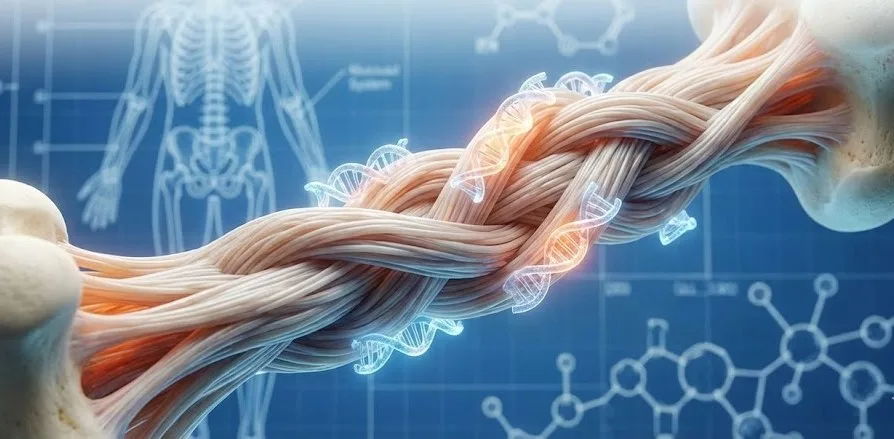
Tendons are dense, fibrous connective tissues composed primarily of Type I collagen. Their primary role is to transmit forces generated by muscle to bone, creating movement. The challenge for athletes is the "tendon paradox." While muscles receive ample blood flow and adapt relatively quickly to training stimuli, tendons have poor vascularity and a much slower metabolic turnover rate.
Consequently, muscle strength often develops faster than tendon capacity. When a powerful muscle pulls against a structurally unprepared tendon, micro-tears occur. Over time, this imbalance leads to overuse injuries like tendinopathy, the bane of runners, jumpers, and multidirectional field sport athletes. To build a resilient athlete, one must build resilient connective tissue.
The Mechanism: Feeding the Matrix
Standard dietary protein sources, like whey or meat, are excellent for muscle repair due to their high content of branched-chain amino acids like leucine. However, they lack the specific amino acid profile necessary to rebuild collagen rapidly.
Collagen protein is uniquely rich in three specific amino acids: glycine, proline, and hydroxyproline. These are the essential building blocks required to synthesize new collagen fibrils within the tendon matrix.
Furthermore, recent studies have highlighted a critical cofactor in this process: Vitamin C. Vitamin C is essential for the enzymatic reaction that hydroxilates proline and lysine, a necessary step to form the stable triple-helix structure of mature collagen. Without adequate Vitamin C, collagen synthesis is impaired, leading to weaker tissue. Therefore, effective supplementation strategies must combine hydrolyzed collagen with sufficient Vitamin C.
The New Frontier of Research
Recent groundbreaking research has moved beyond animal models to examine elite human populations. A pivotal 2025 study investigated the effects of supplementing resistance training with hydrolyzed collagen in a particularly vulnerable demographic: elite master female field hockey athletes.
Master athletes face the dual challenge of high-performance demands and age-related decline in collagen synthesis and tendon stiffness. The study utilized an 8-week protocol of heavy eccentric resistance exercise—the gold standard for stimulating tendon adaptation. One group received a placebo, while the intervention group ingested 30g of hydrolyzed collagen and 500mg of Vitamin C prior to training sessions.
The results were significant. While both groups saw muscle improvements due to the training, the collagen group demonstrated superior gains in two critical areas:
-
Increased Tendon Cross-Sectional Area (CSA): The tendons of the collagen group physically grew thicker compared to the placebo group. A thicker tendon is generally a stronger, more resilient tendon, capable of handling higher loads with less strain.
-
Improved Rate of Force Development (RFD): This is a measure of explosive strength—how quickly an athlete can express force. The study found that collagen supplementation augmented the training-induced gains in RFD.
Implications for Athletic Performance
The finding that collagen intake can improve Rate of Force Development is particularly exciting for performance coaches. It suggests that healthier, structurally sound tendons act as more efficient springs.
In dynamic sports involving sprinting, jumping, and rapid changes of direction, the ability of the tendon to store elastic energy during the eccentric (lengthening) phase of movement and rapidly recoil during the concentric phase is vital. A stiffer, healthier tendon transfers force from muscle to bone more effectively, directly translating to improved explosiveness on the field or track.
Practical Applications for the Athlete
The science indicates that athletes can no longer afford to treat connective tissue health as an afterthought. To leverage these findings, athletes should consider the following protocols:
-
Targeted Timing: Collagen synthesis in tendons is stimulated by mechanical loading. To maximize the uptake of the specific amino acids into the target tissue, consuming collagen approximately 30 to 60 minutes before a training session involving heavy loading or plyometrics appears most effective.
-
Adequate Dosage: The research suggests that higher dosages may be necessary for structural change in athletic populations. Dosages of 15g to 30g of hydrolyzed collagen, always paired with Vitamin C (around 500mg), are recommended in current literature.
-
The Training Stimulus is Non-Negotiable: Supplementation alone will not strengthen a tendon. It provides the building blocks, but the training provides the architectural blueprint. Heavy, slow resistance training and eccentric loading protocols remain essential to signal the tendon to adapt.
Conclusion
The athletic community is witnessing a paradigm shift in sports nutrition. The focus is broadening from solely fueling muscles to fortifying the entire musculoskeletal system. By recognizing that tendons are dynamic, adaptable tissues that respond to specific nutritional cues, athletes can take proactive steps to improve their structural resilience, mitigate injury risks, and unlock new levels of explosive performance.