
For the endurance athlete, the concept of "hitting the wall" is a tangible, often devastating reality. It marks the moment when the body’s primary fuel—stored carbohydrate (glycogen)—becomes depleted, forcing a sudden and dramatic slowdown. To avoid this, and to sustain performance over long durations, the body must efficiently transition to using its vast stores of fat. This crucial metabolic switch is not a simple on-off lever; it is a complex, meticulously regulated process managed by microscopic gatekeepers within the muscle and fat cells. At the heart of this regulation is the interplay between the lipase enzyme, Hormone-Sensitive Lipase (HSL), and the protective protein Perilipin.
The Lipolytic Engine: HSL and the Lipid Droplet
Lipids, or fats, are stored within cells in specialized organelles called lipid droplets (LDs). These droplets are not merely passive storage depots; they are highly dynamic structures surrounded by a protective layer of proteins. In both adipose (fat) tissue and skeletal muscle, the process of breaking down stored fat—known as lipolysis—is primarily regulated by HSL and another enzyme, Adipose Triglyceride Lipase (ATGL).
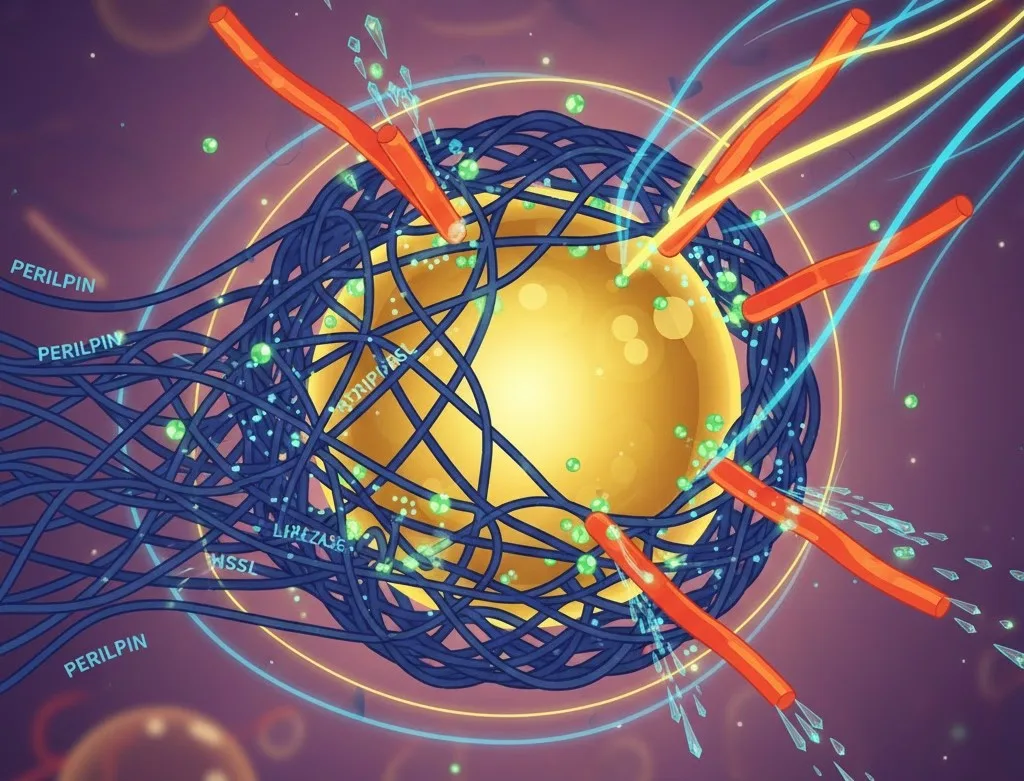
However, the key to accessing these reserves lies in the action of Perilipin. Perilipin proteins form a protective coat around the lipid droplet, acting as a molecular shield that physically blocks HSL from reaching its triglyceride substrate. This mechanism ensures that fat reserves are not indiscriminately broken down when the body is at rest.
The Phosphorylation Signal: Unlocking the Fuel Tank
During exercise, especially moderate to high-intensity endurance efforts, the body’s hormonal landscape shifts rapidly. The release of catecholamines (like adrenaline and noradrenaline) increases, signaling to the cell that an immense energy demand is present. This signal triggers a cascade involving cyclic AMP (cAMP) and Protein Kinase A (PKA).
The true metabolic unlock occurs when PKA activates HSL through a process called phosphorylation (adding a phosphate group). Crucially, PKA also phosphorylates the Perilipin proteins coating the lipid droplet (specifically, Perilipin 1 in fat tissue and Perilipin 5 in muscle). This phosphorylation of Perilipin causes a dramatic conformational change, forcing the protein to move or restructure and physically exposing the stored triglycerides. The newly activated HSL can then move from the cell's cytosol to the droplet surface, where it finally gains access to its substrate and begins the process of hydrolysis, releasing free fatty acids (FFAs) for use as fuel.
This HSL-Perilipin dynamic is the molecular switch that governs fuel availability:
-
Resting State: Perilipin shields the fat, keeping lipolysis at a low, basal rate.
-
Exercise State: Hormones trigger phosphorylation of both HSL and Perilipin, opening the gate and initiating a powerful wave of fat mobilization.
The Athletic Advantage: Training and Metabolic Flexibility
For athletes, optimizing this HSL-Perilipin mechanism is central to metabolic flexibility and long-duration performance:
-
Enhanced Endurance: Endurance training increases the body's reliance on fat oxidation during submaximal exercise. A key adaptation is the increased expression of Perilipin 5 and HSL within the muscle fibers (intramyocellular triglycerides). This allows trained athletes to more readily tap into local fat reserves, sparing limited muscle glycogen for high-intensity bursts or the final sprint.
-
Increased Sensitivity: Training improves the sensitivity of both adipose tissue and muscle to the catecholamine signal. A fitter athlete can initiate and sustain a higher rate of lipolysis at a lower exercise intensity, thereby conserving carbohydrate stores.
-
Fueling the Second Half: The efficient breakdown of fat, enabled by the HSL-Perilipin axis, provides the sustained energy necessary for the later stages of a marathon or ultramarathon. The faster and more fully an athlete can shift their metabolism toward fat, the longer they can maintain pace without the catastrophic bonk caused by glycogen depletion.
In essence, while visible fitness is measured in strength and speed, true metabolic fitness is measured in the efficiency of these intracellular gatekeepers. The well-trained body is one that has biologically programmed its HSL-Perilipin system to quickly and effectively transition to its most abundant fuel source—fat—turning stored energy into sustained athletic performance.