
Creatine monohydrate has long stood as one of the most effective and widely researched performance-enhancing supplements for athletes seeking improvements in strength, power, and high-intensity exercise capacity. However, recent advancements in sports nutrition are focusing on the creatine precursor, Guanidinoacetic Acid (GAA), which is now being studied for its potential to offer a synergistic advantage over creatine alone. Understanding the synthesis pathway and the role of GAA is becoming critical for athletes and coaches aiming for maximized muscular and neurological performance.
The Creatine Synthesis Pathway and GAA's Role
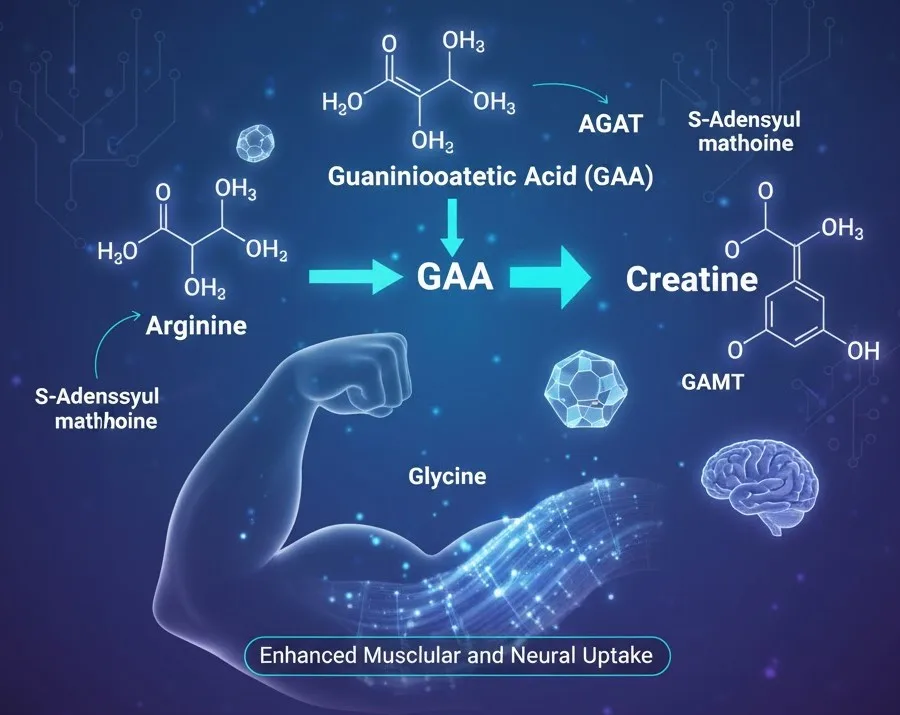
Creatine is naturally synthesized in the body, primarily in the liver and kidneys, through a two-step process that utilizes the amino acids arginine and glycine. The first and rate-limiting step involves the enzyme Arginine:glycine amidinotransferase (AGAT), which produces Guanidinoacetate (GAA). GAA is then transported to the liver where it undergoes a methylation step, catalyzed by Guanidinoacetate methyltransferase (GAMT) and using S-adenosylmethionine (SAMe) as a methyl donor, to finally form creatine.
This pathway confirms that GAA is the immediate biochemical precursor to creatine. By introducing exogenous GAA, supplement strategies bypass the initial, often slower, step of the synthesis process, potentially leading to more rapid or complete saturation of the body’s creatine stores.
GAA Supplementation: A Synergistic Strategy for Athletes
Creatine's primary function in muscle tissue is to replenish adenosine triphosphate (ATP)—the energy currency of the cell—during short bursts of intense activity (e.g., heavy lifts, sprints). The goal of creatine supplementation is to increase the total pool of phosphocreatine available in the muscle cell.
Research suggests that co-ingesting GAA with creatine may be more effective than creatine alone in achieving this goal, particularly regarding two key areas:
1. Enhanced Muscular and Neural Creatine Uptake
While creatine supplementation effectively raises muscle creatine stores, the potential addition of GAA may enhance the overall saturation. Crucially, GAA is structurally smaller and more lipophilic than creatine, which may allow it to cross biological barriers, like the blood-brain barrier, more easily. Studies indicate that GAA supplementation can lead to a more pronounced increase in cerebral creatine stores compared to creatine monohydrate.
For athletes, optimizing brain creatine is significant for cognitive functions tied to sport performance, such as reaction time, complex decision-making, and reducing mental fatigue during prolonged high-intensity efforts.
2. Optimization of Creatine Loading
For athletes, especially those in sports requiring explosive power (e.g., powerlifting, rugby, sprinting), rapid creatine loading is a common practice. If GAA provides a more efficient route to creatine synthesis and saturation, it could potentially optimize the loading phase, leading to performance benefits sooner or with lower overall doses. This could also be a benefit for individuals who are classified as "non-responders" to standard creatine supplementation.
Consideration of Methylation Load and Safety
When considering GAA supplementation, athletes must also understand its metabolic implications. The conversion of GAA to creatine is a methylation-intensive process, consuming SAMe. While the body can typically manage this process, prolonged high-dose GAA supplementation could theoretically increase the demand for methyl-donors, such as those supplied by folate and Vitamin B12.
Current studies are diligently investigating the appropriate dosages and long-term safety profile of GAA, particularly concerning the potential for elevated homocysteine levels (a byproduct of SAMe use). For practical application, athletes interested in incorporating GAA should prioritize a diet rich in B vitamins and consult with a sports nutritionist to ensure proper balance and dosing.
In conclusion, as sports science evolves, the simple approach of creatine monohydrate may be giving way to more sophisticated, pathway-specific strategies. GAA represents a compelling frontier in performance enhancement, offering the promise of a more comprehensive and potentially synergistic approach to maximizing both muscular force generation and neurological readiness in the athletic population.