The pursuit of peak athletic performance often intersects with strict regulatory frameworks designed to maintain fairness and safety. Within competitive sports, rumors and misconceptions regarding drug testing frequently circulate among athletes and support personnel. One of the most persistent myths is that high doses of caffeine or other common stimulants can "mask" the presence of anabolic-androgenic steroids (AAS), such as Anavar (oxandrolone), during a urine doping test.
Understanding the physiological and analytical reality of modern testing demonstrates why these myths are scientifically unfounded and why the use of true masking agents carries severe consequences in athletic competition.
The Chemical Reality of Anavar Detection
Oxandrolone is an oral anabolic steroid known for its ability to promote tissue repair and lean muscle mass while exhibiting a specific metabolic profile. When an athlete undergoes an anti-doping screening, laboratories do not look for the parent compound alone. Instead, they test for the metabolic byproducts excreted in the urine.
-
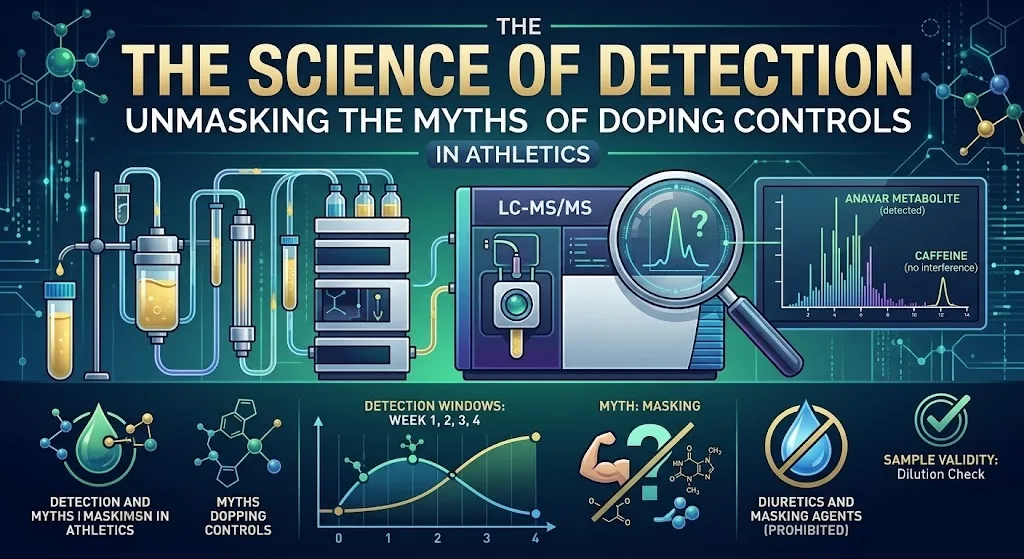
Mass Spectrometry: The standard testing method utilizes liquid chromatography-tandem mass spectrometry (LC-MS/MS) and gas chromatography-mass spectrometry (GC-MS). These instruments isolate compounds based on their molecular weight and chemical structure.
-
Long-Term Detection Windows: Oxandrolone metabolites can remain detectable in urine samples for three to four weeks post-administration.
-
Independent Pathways: Caffeine and oxandrolone metabolites have vastly different molecular weights and chemical properties. The presence of high concentrations of caffeine does not alter the structure, retention time, or mass spectrometric signature of oxandrolone metabolites.
The Role of Caffeine in Sports
The World Anti-Doping Agency (WADA) continuously updates the list of prohibited substances. Caffeine is currently not classified as a banned or prohibited substance. Under the WADA Monitoring Program, caffeine remains under observation to track usage trends among athletes.
Consuming high doses of caffeine prior to or during a competition will yield an elevated level of the stimulant in a biological sample, but it does not interact with or hide anabolic steroids. In fact, if urinary concentrations exceed certain institutional limits—such as those upheld by the NCAA—the athlete may face disciplinary action for the stimulant itself.
The Fallacy of Masking with Diuretics
While caffeine does not alter test results, the misconception regarding "masking agents" often stems from the historical misuse of diuretics. Diuretics are classified under the S5 category (Diuretics and Masking Agents) of the WADA Prohibited List and are banned both in and out of competition.
Historically, athletes attempted to use diuretics to induce polyuria (excessive urination), hoping to dilute the concentration of prohibited substances below the laboratory reporting threshold. Modern anti-doping protocols counter this strategy through several layers of analysis:
-
Sample Validity Testing: Laboratories measure specific gravity and urinary creatinine levels to check for dilution. If a sample is overly diluted due to excessive fluid or diuretic use, the sample is flagged, and the athlete may be subject to immediate re-testing under supervision.
-
High Sensitivity Assays: Modern LC-MS/MS systems are capable of detecting trace amounts of steroid metabolites even in highly diluted urine.
-
Dual Infractions: Using a masking agent is an independent anti-doping rule violation. If a laboratory detects a diuretic in a sample, the athlete is penalized regardless of whether an anabolic steroid is found alongside it.